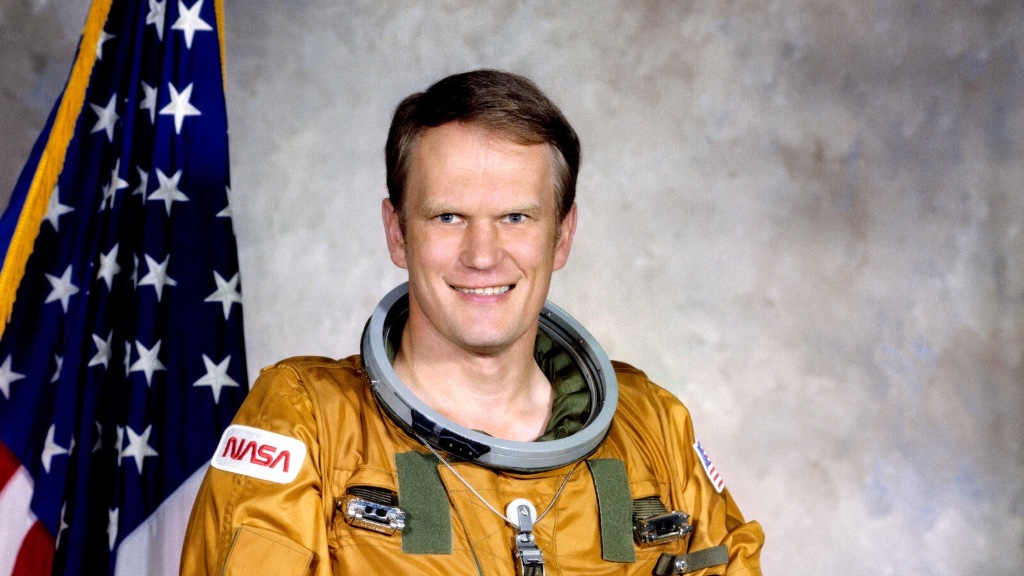
Karol J. Bobko was an American astronaut, aerospace engineer, and Air Force officer who played a major role in the development of the United States space shuttle program. Known by the nickname "Bo", Bobko became one of NASA's most accomplished shuttle astronauts during the 1980s. Over the course of his career, he flew on three separate space shuttle missions and became the first person to fly aboard three different shuttles. His work helped advance human spaceflight and inspired future generations interested in science and exploration [2].
Karol Joseph Bobko was born on December 23, 1937, in Queens, New York. He attended Brooklyn Technical High School before enrolling in the United States Air Force Academy, where he graduated in 1959 as part of the academy's very first graduating class. Later, he earned a master's degree in aerospace engineering from the University of Southern California. After completing pilot training, Bobko served as a fighter pilot in the United States Air Force, flying aircraft such as the F-100 and F-105. He eventually attended the Aerospace Research Pilot School at Edwards Air Force Base, where he trained as a test pilot and prepared for future spaceflight opportunities [3,4].
Bobko originally trained for the Air Force's Manned Orbiting Laboratory program, a secret military space project during the Cold War. Although the program was canceled in 1969, NASA selected Bobko and several other pilots to join its astronaut corps as part of Astronaut Group 7. At NASA, he worked on important programs including the Skylab Medical Experiment Altitude Test and the Apollo-Soyuz Test Project, which marked the first joint space mission between the United States and the Soviet Union. In addition, he helped with early testing of the space shuttle program before finally flying into space himself [3,4].
Bobko's first mission in space was STS-6 in April 1983 aboard the space shuttle Challenger. This mission was historic because it was Challenger's maiden voyage. During the mission, the crew deployed a communications satellite and conducted the first-ever shuttle spacewalk. That same year, Bobko commanded two additional missions: STS-51-D aboard Discovery in 1985 and STS-51-J aboard Atlantis later. Remarkably, he became the only astronaut to participate in the first flights of two separate space shuttles, Challenger and Atlantis. Altogether, Bobko spent more than 386 hours in space [3,4].
Beyond his achievements in space, Bobko was highly respected for his leadership and dedication to aerospace innovation. After retiring from NASA and the Air Force in 1988 as a colonel, he continued contributing to space exploration through companies such as Booz Allen Hamilton and SPACEHAB. Moreover, he worked with NASA Ames Research Center on advanced flight simulation programs. Throughout his life, Bobko received many honors, including the Distinguished Flying Cross, NASA Space Flight Medals, and induction into the U.S. Astronaut Hall of Fame in 2011 [3,4].
"His accomplishments demonstrated courage, intelligence, and determination during an important era in NASA history."
Karol J. Bobko died on August 17, 2023, at the age of 85, but his legacy continues to influence the world of aviation and space exploration. His accomplishments demonstrated courage, intelligence, and determination during an important era in NASA history. As one of the pioneers of the shuttle program, Bobko helped shape the future of human space travel and remains an inspiring figure for students, scientists, and astronauts around the world [3,4].
References
- https://web.archive.org/web/20140809083554/http://www.vu.lt/en/news/2708-lecture-of-nasa-astronaut-karol-j-bobko
- https://bthsalumni.org/karol-bobko-55-nasas-first-challenger-pilot/
- https://news.va.gov/105165/veteranoftheday-air-force-veteran-karol-j-bobko/
- https://www.nytimes.com/2023/08/24/us/karol-bobko-dead.html
- https://www.americaspace.com/2023/10/03/a-mission-not-so-secret-remembering-atlantis-maidenflight-otd-in-1985/