Guarding Young Minds in the Digital Age
Charlotte Walls interviews Professor Jonathan Haidt
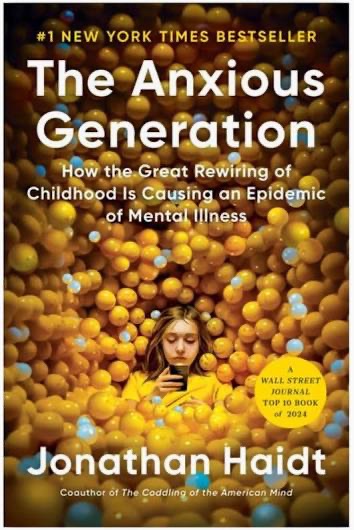

Professor Jonathan Haidt is a leading social psychologist and professor at the New York University Stern School of Business. He is the author of the New York Times #1 bestsellers The Anxious Generation: How the Great Rewiring of Childhood Is Causing an Epidemic of Mental Illness (2024) and The Amazing Generation: Your Guide to Fun and Freedom in a Screen-Filled World (2025), co-written with Catherine Price. He has also authored The Happiness Hypothesis (2006), and the New York Times bestsellers The Righteous Mind (2012) and The Coddling of the American Mind (2018), co-written with Greg Lukianoff. He received his Ph.D. from the University of Pennsylvania in 1992 and taught for 16 years in the Department of Psychology at the University of Virginia. His current work focuses on how the rise of social media and AI is reshaping childhood and mental health.
Charlotte:What experiences in your early life sparked your curiosity about human behavior and psychology?
Professor Haidt
I would have to say it was really taking an introductory psychology course during my freshman year of college. I had taken a bad psychology course in high school. I kind of liked it, but I didn't think much beyond that. Then, as a freshman in college, I took a really good psychology course and just loved it. It was so interesting. Even though I had committed to becoming a philosophy major, I went on to take a number of psychology courses and followed what was called the psychology track within the philosophy department. Ever since, I have always mixed psychology and philosophy to help understand the human condition.
Charlotte:Can you describe a key turning point in your career that influenced the direction of your work? Were there any teachers, books, or moments that shaped your path?
Professor Haidt
There were many teachers and books along the way that shaped my path. One major turning point came when I decided to go to graduate school in psychology. I was planning to study cognitive psychology, but I had a great discussion with a professor who was studying moral psychology, and I thought that sounded fascinating. As a result, I changed the direction of my work and even changed my advisor during my first year of graduate school at Penn. Studying morality has been fantastic because it is connected to everything people do together. We are always judging one another, and we are always concerned about what others think of us. Much of my original research was in moral psychology, and that became the foundation of my career. What I am doing now — studying social media, smartphones, and kids — is newer work. It has required me to learn a great deal of new material.
Charlotte:How would you explain your work in social psychology to a high school audience and how has your thinking evolved over time? What is one idea from your research that you think every high school student should understand?
Professor Haidt
"Your attention is the most precious thing you have, and you must not waste it. You must not give it to companies that are trying to addict you and capture your attention."
Charlotte:What questions about human nature still fascinate you today?
Professor Haidt
Oh, so many! From my research and from what we know in moral psychology and social psychology, I think I have a pretty good grasp of human nature. The question that interests me is: how do we design a society that takes account of human nature and gives us good results? This turns out to be exactly the question that the Founding Fathers were thinking about in Philadelphia: James Madison, Thomas Jefferson, and Ben Franklin. They were brilliant. They were trying to design a system of government that would work for people who were easily swayed by their emotions and who were often very selfish. They had a really good grasp of human nature and social psychology. Though the harder problem is, if that's what people are like, what kind of government will give you good results and not decay into tyranny? That was their big question, and that's the question I'm still working on today, because technology is changing how we behave in ways that are very bad for democracy.
Charlotte:What do you think is the effect when people used to get their news from newspapers, but now they get it from social media? What effect do you think that has on the nature of American democracy?
Well, I feel that on social media, since it is driven by an algorithm, you are given videos that the algorithm thinks you would enjoy. So you are being fed information that you would probably like. For example, if you are more liberal, you are probably being fed more liberal information, and if you are more conservative, you are probably being fed more conservative information. That keeps people in a loop, as seen during the 2024 election. People who were liberal thought that Kamala was going to be the new president because they were only being fed information from other people who also liked Kamala, rather than looking at information from people who were more conservative and planning to vote for Trump. So that is why I think there was a big shock to liberals in the way the election turned out. They were not branching out to other opinions.
Professor Haidt
Yes, you're on the right track here. If each person is getting the information they like, or that their team likes, then we're not living in the same reality, and so we can't really talk. Democracy is a conversation. Originally, it was a conversation among the men of Athens. They would get together, they would talk, and that was Greek democracy. Then it became a conversation among the men of the United States, but they would talk through newspapers and pamphlets. And now it's a conversation among everybody yelling at each other on X or Twitter. As technology changes, the nature of what we know and how we talk to each other changes. My fear is that social media makes us take in information, as you said, just from our side and makes us hate the other side, and so this is driving polarization. So now, what is AI going to do? Everybody has their own chatbots that talk to them, and things we see on social media will increasingly be made by AI and not by human beings. Things made by AI may be more beautiful, more gripping, and more amazing. So my fear is that generative AI will shatter any possibility of living in a shared reality, and that would be very dangerous for democracy.
Charlotte:I completely agree with you that at puberty more kids are being drawn into social media and their brains are changed from that, but would you say that you see that in adults that you're surrounded by as well?
That's a very good point. It is affecting everyone. It's affecting what we do, it's affecting what we think, and it's affecting how we feel. The difference is that the effects on adults are temporary because our brains are kind of locked down by the age of 25. There's very little change after that. I mean, there's always learning, but the basic structure of your brain remains the same. Here's where biology comes in. In puberty, neurons are sending out many new dendrites and connecting differently, and the long axons are getting myelinated based on the circuits that get used. So the effects on kids in puberty are more likely to be permanent. Whereas, if adults take a one-month detox, they'll get their brain back. There's a great book called Stolen Focus by Johan Hari, where he does this. He goes to Provincetown in Cape Cod for the whole summer and doesn't use any devices. It's very hard at first, but he gets his focus back. So you're absolutely right to say that adults are doing this too. But my focus has been on kids first because the changes are much more serious, since they could be permanent, and second, because it's very hard to tell adults what to do or to make any change that limits what they can do. But in civilized nations, we have laws to protect children from addictive activities. And so drugs, alcohol, gambling, and, I would say, social media need to be adult-only activities, and that's what I'm advocating for.
Charlotte:If you could design an ideal society, what would it look like in terms of human relationships, values, and the role of technology?
Professor Haidt
"When technologies separate us and shatter our shared reality, they're very destructive. I believe social media has been catastrophic for humanity. And AI will be even worse."
Charlotte:Do you think there's any way that students can use things like social media or AI in a helpful way or do you think that it's all harmful?
Professor Haidt
I think, on balance, it is harmful. Certainly for ages below 16, and I think overall nobody should be using it at all because it is hard to resist. Under 16, your executive function areas in your frontal cortex, the planning and self-control sections, are not mature. Then I think social media and AI are overwhelmingly harmful. Once kids become 16, 17, or 18, they often begin to get more interested in politics and in social activism, and social media is helpful in getting the word out, in running campaigns, and in creating change. So I wouldn't say that it is all bad, although I think the world would be so much better off if Meta, Facebook, Snapchat, and TikTok had never been invented. So yes, there are some good things. None really for those under 16, some for those over 16, but overall it is very destructive of human happiness and our ability to live together.
Charlotte:At Brooklyn Technical High School, students are deeply engaged in science and engineering. What advice would you give them as they go forward and they pursue innovation?
Professor Haidt
"Humanity is playing with the most dangerous fire it has ever played with, with AI."
Charlotte:Where do you see AI going in the future, and how do you see that affecting our future society?
Professor Haidt
I think it's going to have many, many effects. It will have positive effects, like speeding up scientific discovery and cures for disease. It may bring prosperity, although we don't know if that will be shared. So there will certainly be upsides. But what I'm most concerned about is AI agents and then robots. What we've seen so far is generative AI, which is fun and amazing and helpful and brilliant and interesting. It's giving us all omniscience. Omniscience means you can know everything, and you can make beautiful things. But agents are just beginning to come in. So far, the AI we've been dealing with tells us things or makes things for us. Agents, or agentic AI, have the ability to act on your behalf. And that sounds nice, but that also gives everyone the ability to say something like, I really don't like Bob Smith. He really hurt me. So go out and ruin his life. Agent, figure out a way to ruin his life, and make sure that I'm not implicated. If everyone has the capacity to do anything, that means that people who want to hurt others or cause destruction will have these powers. So, I think that we cannot even look at the early AI era to understand what the later AI era will be, because agentic AI is very new and very different, and very few of us have seen it.
Charlotte:If you could give your high school self one piece of advice, what would it be?
Professor Haidt
My high school self? Let's see, it's hard because I wouldn't want to change anything about how my life went. You don't know where it would end up. I think it would be to read Stoicism and get your daily routines right, because that will set you up for better thinking and better days. So yes, I would recommend Stoicism to my early self, like Marcus Aurelius and Epictetus. I think that's the most useful philosophy that humanity has ever come up with for life in our modern times.
Charlotte:Have you seen firsthand how the effects of social media and AI are already changing teenagers?
Professor Haidt
As a professor at NYU, I don't see the worst cases. Fifty percent of American teenagers are on social media five hours a day, and most of them are not going to go to a good college. They're not going to get in because they can't think. So the students that I encounter are not so addicted. I teach a class called Flourishing, and we work on getting daily habits better. In every class of 30, there are usually five who are on social media for four hours a day or more. That is devastating to their day, and it's devastating to their focus. The ones who go from four hours a day or more down to one hour a day get transformations in their lives. They suddenly have so much time. They can do their homework quickly because they're not distracted. And they're getting back three or four hours a day, so they suddenly realize there's no time pressure. I'm not in a hurry anymore. I can enjoy myself. I can go out with friends. I can play sports. I can have fun. And so, I see the transformation in students every semester in those who get off social media. I read their papers about how they struggle to read books and how they struggle to focus. So this is why I think the verdict on social media is not close. The pluses are so tiny compared to the minuses. I think the devastation is so deep. There is no way to make it safe for kids. We just have to stop kids from being on it until at least 16.
Charlotte:You talked about how during puberty, that's the most important time for your brain development. Do you think that a teenager's brain is permanently damaged even after going from four to one hours of screen time?
Professor Haidt
That's a very good question. We don't know the answer for sure. This is all very new. But here's what I think is happening. Because it is a sensitive period, people who have been users all through it will be changed in a negative way. They can't get back to where they would have been if they'd had a normal human childhood. But they can get a lot of the way back, maybe most of the way back. Now, if you use social media until you're 27, then it is more difficult. Puberty is the main window of rapid brain change, and the brain is still somewhat malleable up to 25, but it's hard to get brain changes after 25. So college students are still within the window where changes to habits will have permanent, lasting structural changes in their brains. So what I think is going to happen is that Gen Z is going to be permanently damaged in their attentional capacities, on average, and I think Gen Alpha is going to be even worse because Gen Alpha are the iPad babies. A lot of them have been on their iPads since they were two. So I think we're going to see two generations whose attentional capacities are permanently damaged. But, and this is very important, those who make the effort to get it back as teens or in their early 20s, I think they will get most of it back.
Charlotte:Many kids like the iPad babies that you were just talking about are given them by their parents. What would you like adults to do instead of giving their children iPads?
Professor Haidt
Yes, so you put your finger on the central problem, which is the collective action problem. We all see everybody else doing it, and so we want that too. What parents discover is their kid desperately wants your phone or your iPad. It's the most interesting thing they've ever seen. Every child wants it. It's colorful, it responds, you touch it. It is absolutely magnetic to every young human being. What we've all discovered, all of us parents, is if you just give the kid the device, they're quiet, and then I can make dinner, and I can do my email, and I can look at my social media. And so that's what everyone did. And everybody thought, well, everyone else is doing it, so it must be okay, and the kid's happy. But then what everyone is discovering is that when you try to take the iPad away, their dopamine system has adapted to high levels of dopamine. And therefore, when you take it away, they suddenly have low levels of dopamine. And if you have low levels of dopamine, it's the opposite of pleasure. You feel irritable, it almost hurts, you're bored, you're anxious. And so, what's the cure? You give the kid back the device. And that just makes it worse and worse and worse.
Charlotte:You were talking about how children's attention spans are decreasing with the usage of social media. Do you think that's a cause for more people getting diagnosed with ADHD, ADD, and other attention disorders?
Professor Haidt
I looked into that while writing The Anxious Generation. I did not find evidence that these digital activities are causing ADHD. What I did find, from multiple studies, is that for kids who have ADHD, these things make it a lot worse. So if your brain already has some attentional problems, you're much more easily hooked. And then your symptoms get much worse. So I can't say that it is causing these diagnoses, but I can say that it is exacerbating it for those who have it.
Charlotte:Is there anything important that you wish more people would ask you about, or something that we didn't cover today that you would like to share?
Professor Haidt
"Your brain is, in essence, an LLM — if you focus on developing your own and not giving your attention away, you're going to be much more successful in life and much happier."